
To A/B test a mix, play two versions of the same song in sync, match their loudness, and switch between them at the same moment in the song. Listen to short sections, judge one thing at a time, and decide before you check which file is which. The loudness match matters most. A version that is about 1 dB louder can win only because it is louder.
What an A/B test of a mix is
An A/B test compares two versions that differ in one way. That can be two mix revisions, a mix and its master, two masters of the same mix, or your mix against a reference track. You listen to A, switch to B, and decide which one is better for a specific quality, such as the vocal level or the weight of the kick.
The test works only if the switch is instant and lands at the same point in the song. If you stop A, open B and press play from the top, you compare your memory of the chorus in A with the intro of B. Small differences get lost in that gap.
Prepare the files
- Bounce both versions from the same start point, so the first sample of each file is the same moment in the song.
- Use lossless files (WAV, AIFF or FLAC) when you compare mix decisions. If one file is an MP3 and the other a WAV, you are testing the encoder as well as the mix.
- Change one thing between versions when you can. If B has a new vocal level and a new bus compressor, a win for B doesn't tell you which change helped.
- Name the files so you can tell them apart in the results, then try not to look at the names while you listen.
To check the alignment, loop a drum hit and switch on it. If the hit flams or plays twice, the files are offset and need to be bounced again from the same start.
Match the loudness first
Ears are less sensitive to lows and highs at low levels. This is the equal-loudness effect described in ISO 226, often called the Fletcher-Munson curves. Turn a version up and it sounds fuller and brighter. A difference of about 1 dB is enough to bias the comparison, so the louder mix usually wins, even when the quieter one is better balanced.
Match by integrated loudness in LUFS, not by peak level. Two masters can both peak at −1 dBTP and still be several LU apart, because one is more compressed. Measure each file's integrated LUFS, then turn the louder file down by the difference. If the master reads −9 LUFS and the mix −11 LUFS, turn the master down 2 dB.
Turn the louder file down rather than the quieter one up. Turning down can't push anything into clipping. The level matching guide covers the method in full, including a worked example with three files.
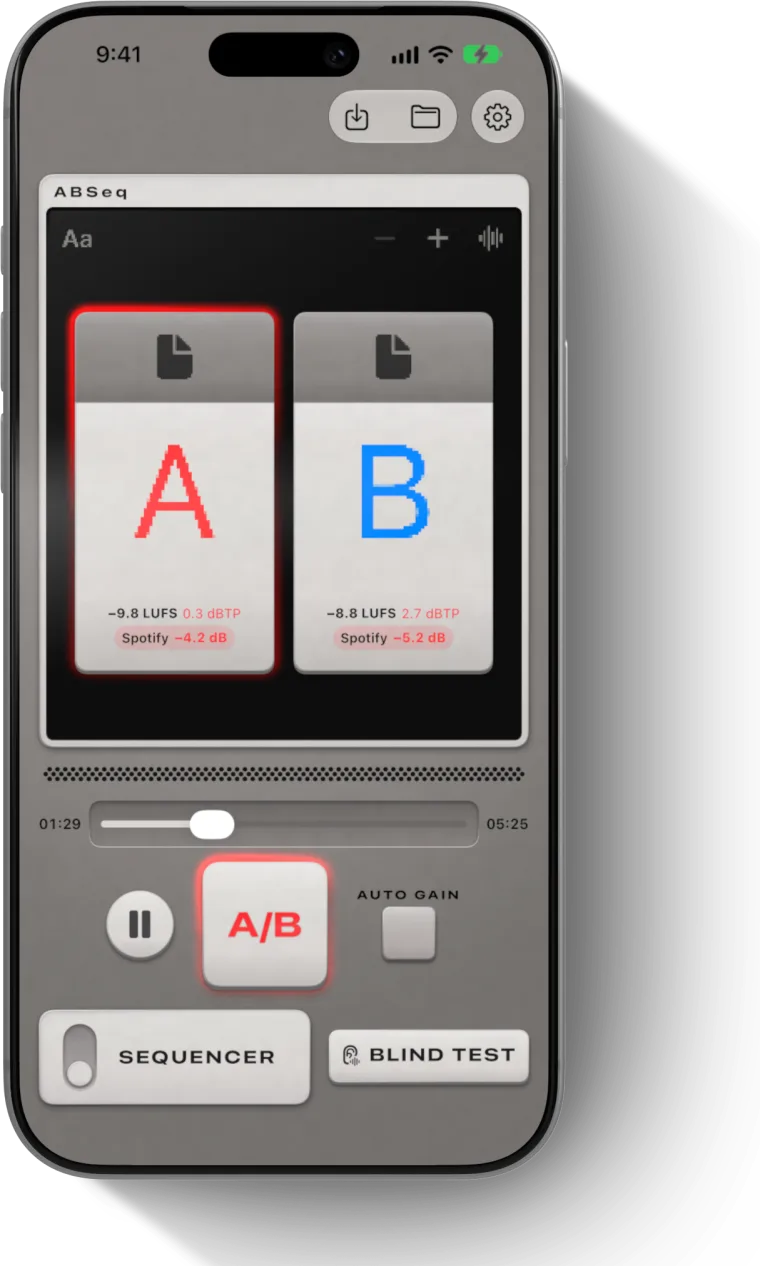
In ABSeq, Auto Gain does this step. It measures each file's integrated loudness and turns every track down to the quietest one, and never turns a track up. The help guide explains how Auto Gain matches levels.
Switch in sync, on short sections
Pick one section, such as the first chorus, and loop it. Listen to a few bars of A, switch, and listen to the same bars of B. Then switch back. A sync player keeps both versions running and changes only which one you hear, so each switch lands mid-phrase with no gap and no restart.
Switch often. On a long listen your ears adapt to the version you're hearing, and the first seconds after a switch are where the difference is clearest. Repeat the test on the verse and the drop, because a change that helps the chorus can hurt the quiet parts.
You can also let a sequencer switch on the beat. At 120 BPM, switching once per bar gives you 2 seconds of each version, over and over, with your hands free and your eyes off the screen. The ABSeq sequencer switches on any beat division from 1/32 to 1/1, at a tempo you set or the tempo detected in a track.
Listen for one thing at a time
Decide what you are testing before you press play, and write it down. Typical questions are:
- Does the vocal sit above the snare, or fight it?
- Do the kick and bass both read in the low end?
- Is the chorus wider than the verse?
- Are the cymbals or the "s" sounds in the vocal harsh?
After each pass, note which version won for that question. One version can win the vocal and lose the low end. That result is useful, because it tells you which part of B to carry back into A.
Add a reference track
Both versions can be wrong in the same way, for example both too dark. A commercial track in the same genre, matched to the same loudness, shows that. Released masters are often far louder than a mix in progress, so the loudness match matters even more here. The reference tracks guide explains how to choose one and what to listen for.
Remove the bias of knowing which is which
If you know which file is the new revision, or the one you paid for, you tend to hear it as better. Close your eyes while you switch, ask someone else to switch for you, or run a blind test.
A blind A/B test plays the same passage from both versions in shuffled order and shows the names only at the end. If you pick the same version 9 times in 10 rounds, chance is an unlikely explanation. If your picks split close to 5 and 5, the difference is too small for you to prefer either one.
Check on more than one system
A change that wins on studio headphones can lose on a phone speaker, where there is little low end, or in a car, where road noise covers quiet details. Repeat the key comparisons on two or three systems before you commit. The car test guide covers what to listen for away from the studio.
Common mistakes
- Comparing at different loudness, so the louder version wins.
- Restarting each version from the top of the song instead of switching in sync.
- Changing several things between A and B, so the result can't tell you which change mattered.
- Comparing a WAV mix against an MP3 of the other mix.
- Listening loud for hours. Long, loud sessions tire your ears and blur small differences, so take breaks and keep the volume moderate.
Questions
How do I A/B compare two mixes?
Bounce both mixes from the same start point, measure their integrated LUFS and turn the louder one down to match, then play them in sync and switch at the same moment in the song. Loop one section, decide what you are listening for, and switch every few bars.
Should A/B comparisons be at the same volume?
Yes. Ears hear more lows and highs at higher levels, so a version that is about 1 dB louder sounds fuller and brighter and tends to win. Match the files by integrated LUFS before you judge them, and turn the louder one down rather than the quieter one up.
How do I compare my mix to a reference track?
Pick a released track in the same genre, turn it down to the integrated loudness of your mix, and play both in sync. Compare one quality at a time, such as the vocal level or the low end, and treat the reference as a check on balance, not a sound to copy.
How long should I listen to each version in an A/B test?
Listen to a few bars of each and switch often. On a long listen your ears adapt to the version that is playing, and the difference is clearest in the first seconds after a switch. At 120 BPM, one bar of each version is 2 seconds.
Can I A/B test a mix against its master?
Yes, but match the loudness first. A master is usually louder than the mix, so without matching it wins on level alone. Turn the master down to the mix's integrated LUFS, then judge what the mastering changed in tone, width and dynamics.